Instructional Designer | Researcher in Media, Memory & Pedagogy

Pablo Superstar: Public Pedagogies in Generation Z’s Cultural Memory of Escobar and Narco-Trafficking
Project Overview
As part of my doctoral defense, I created a series of AI-generated posters that transformed complex research findings into visual pedagogical provocations. These posters, grounded in the voices of Medellín's youth and theoretical frameworks on cultural memory, were designed to serve as public pedagogy: accessible, affective, and critical.
The poster series was conceived as a narrative learning arc, combining concepts like prosthetic memory, mythmaking, and mediated identity, and using visual metaphors such as hippos, bombs, and digital devices to illustrate the tension between lived memory and media narratives. Each poster was built from AI-generated prompts (via Sora), with original captions and design direction by me.
Purpose of the Poster Series
To reimagine the thesis defense as an act of public pedagogy by:
-
Translating complex theoretical arguments into emotionally resonant visual narratives
-
Engaging academic and non-academic audiences through storytelling, symbolism, and multimodal literacy
-
Demonstrating how AI tools can serve pedagogical purposes in academic communication
-
Model instructional design that integrates research, media literacy, and identity
Key Learning Objectives (for viewers)
-
Engage with cultural memory through affective storytelling
-
Reflect on how youth in Medellín internalize and reinterpret media narratives
-
Understand the pedagogical role of media representations in shaping memory and identity
Instructional Design Approach
This presentation was built on the principle of aesthetic and narrative immersion. Viewers were invited not only to read the thesis but to feel it through a sequence of visual provocations.
Instructional Strategies embedded:
-
Affective engagement → to trigger reflection and emotional resonance
-
Critical inquiry → prompting questions about memory, identity, and complicity
-
Multiliteracies → combining visual, textual, and narrative literacy forms
Media and Tools
Tool / Approach | Role in Project |
|---|---|
Public Scholarship | Invited viewers to reflect on memory, identity, and violence through visual metaphor |
Multimodal Pedagogy | Structured the poster series to support affective and critical engagement |
Narrative Text Design | Curated and edited for each visual to create a learning arc |
AI-Powered Design | Prompt engineering and visual conceptualization using Sora/OpenAI |
Pablo Superstar Poster Series
AI-Generated Poster Series: Public Pedagogy in Action
Curated and written by Cristina Soto Quintero
This poster series was designed as a visual and narrative extension of my doctoral dissertation, Pablo Superstar: Public Pedagogies in Generation Z’s Cultural Memory of Escobar and Narco-Trafficking. Informed by youth voices, cultural memory theory, and multimodal literacy, the project sought to reimagine the thesis defense as a site of affective engagement and critical storytelling. Each poster was generated through AI prompt design using Sora (OpenAI), then layered with original narrative captions to evoke reflection, discomfort, recognition, and memory disruption. Through metaphors like the hippo, the streaming platform, the classroom, and the mother-child relationship, the series explores how mediated representations of Escobar influence youth identities, emotions, and historical consciousness in Medellín. This was not only an academic exercise, but a design experiment in public pedagogy. I wanted to make the intangible visible, the theoretical touchable, and the academic emotional. This project embodies my instructional design approach: one that integrates emotion, narrative, and critical engagement in educational experiences that go beyond the text.
 Poster 1. Pablo SuperstarThis poster sets the tone for the series by introducing Escobar as a media icon through the figure of the hippo. Its retro-propaganda aesthetic satirizes how pop culture has mythologized his image. |  Poster 2. Four Hippos. One Narco.This poster introduces the beginning of the phenomenon: hippos as Escobar’s legacy, inserting this animal symbol into the national narrative. The map of Colombia and Hacienda Nápoles reinforce the link between territory, legacy, and oblivion. |  Poster 3. Ceci n’est pas un hippoInspired by Magritte, this poster questions representation. The hippo is not just an animal—it is a metaphor, a fiction disguised as memory. It introduces the idea of disconnection between lived experience and representation. |
|---|---|---|
 Poster 4. Where Memory BeginsA mother holding her son stands at the intersection of lived trauma (explosions, fear) and prosthetic memory (streamed representations). This poster stages the emotional and pedagogical terrain of memory entanglement |  Poster 5. Media as Co-Author of MemoryThis poster denounces the dominance of series like Narcos and El Patrón del Mal as primary sources of knowledge about Escobar for Medellín’s youth. It frames media as active co-authors of cultural memory. |  Poster 6. Netflix Teaches More than SchoolA direct critique of how fiction intervenes in education. The “Escobar hippo” appears as a product of objectivation and anchoring: reduced, spectacularized, and streamed. |
 Poster 7. Youth Voices Between Berraquera and ShameAn emotional portrait of the generational dilemma: pride in their roots and “berraquera” versus the shame tied to narco-stigmatized history. Memory is interwoven with memes, family stories, and silence. | 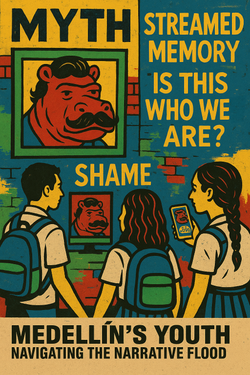 Poster 8. Navigating Narrative FloodsThree teenagers stare at meme-style representations of Escobar. They collectively question whether these media narratives define who they are. |  Poster 9. The Hippo in the RoomA classroom overtaken by a giant hippo symbolizing the disconnect between what students consume through streaming platforms and what formal education offers. Platforms take the lead over pedagogy. |
 Poster 10. Not Erased. Not for SaleThis final poster proposes an ethical stance: memory cannot be erased, but it shouldn’t be commodified either. It calls for a critical, participatory, and intentional stewardship of memory. |
Reflection as an Instructional Designer
This project allowed me to merge rigorous academic research with innovative visual storytelling. By designing a multimodal learning experience for my thesis defense, I demonstrated how AI can extend academic discourse into public pedagogical spaces. The process affirmed my commitment to designing emotionally resonant, intellectually grounded, and technologically integrated educational experiences.